
When we think of Auckland’s native forests, our minds often jump to remote islands or rugged bush reserves at the city’s edge. But deep in the heart of our bustling city lies an unexpected haven for native birds — the Auckland Domain. Beneath its towering trees and winding paths, the Domain has quietly become a sanctuary for a diverse and changing bird community. Thanks to a unique long-term study by Auckland Museum, we’ve been able to uncover how the Domain’s forest bird life has changed over more than three decades — and what that tells us about urban conservation.
Blog by Matt Rayner, Senior Researcher, and Josie Galbraith, Curator of Land Vertebrates Natural Sciences.
Tracking change in an urban forest
Back in the 1980s, Curator of Land Vertebrates Brian Gill conducted bird surveys across the Domain’s central forest block. He used a standard survey method called a five-minute bird count, where all birds seen and heard at a fixed location are recorded for a period of 5 minutes. In 2019–2020, we repeated his exact methodology at the same sites, allowing us to directly compare bird communities over a 30-year span. What we discovered was striking: native and introduced bird species had both increased in abundance and richness.
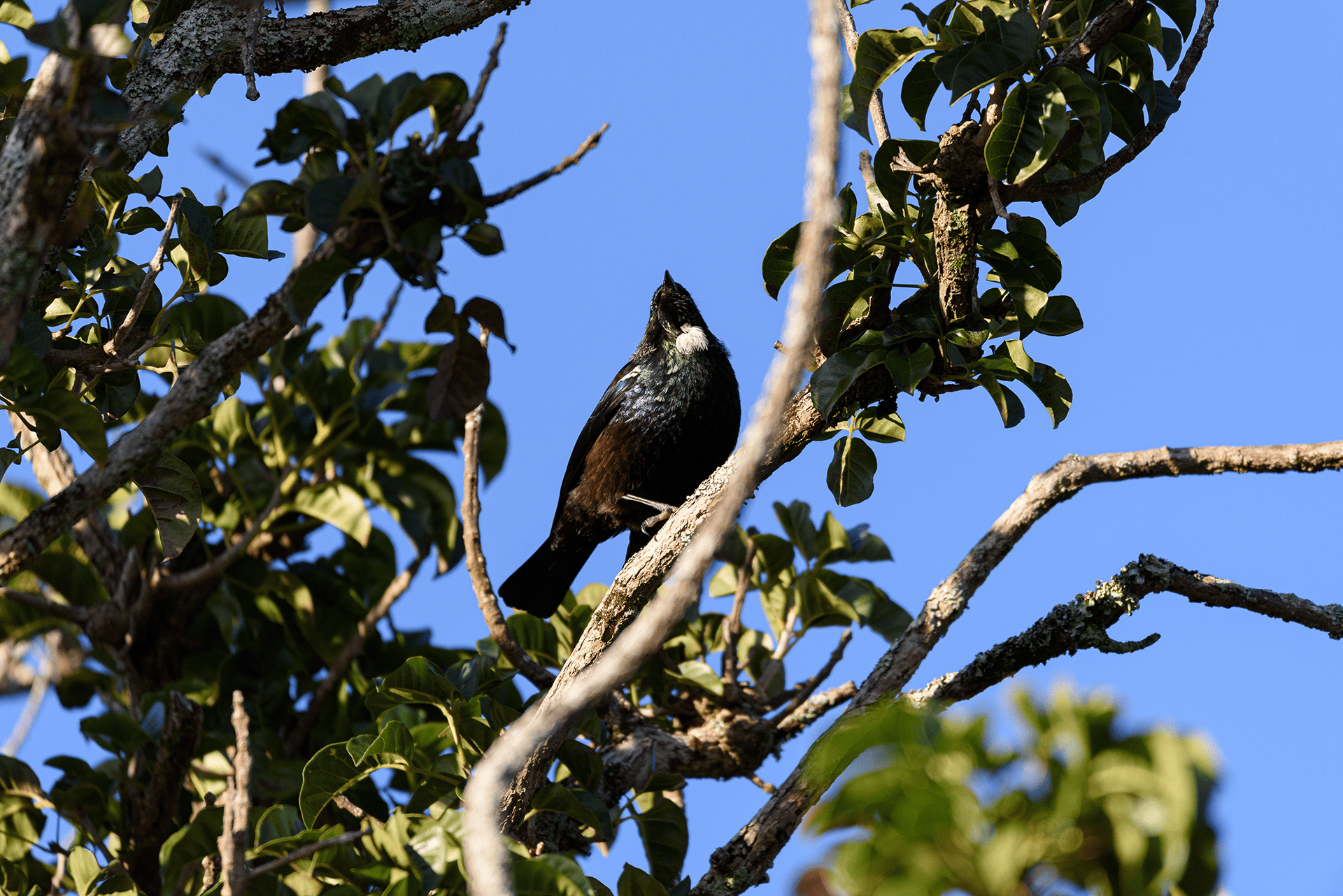
But this wasn’t just a simple case of ‘more birds’. The community had reshaped. Generalist native birds like the silvereye (tauhou) and fantail (pīwakawaka) had declined. In their place, forest specialists like the tūī, kererū, and grey warbler (riroriro) had increased significantly.
Pictured: Tūī (Prosthemadera novaeseelandiae)
Why are forest birds making a comeback?
Urban forests like the Domain are often dismissed as degraded or artificial, but our research shows that mature patches of city forest can provide real refuge for native wildlife — especially when supported by pest control and habitat recovery.
In recent decades, Auckland Council and local volunteers have worked to manage invasive weeds and trap mammalian pests like rats and possums in the Domain. These efforts, along with a natural process of forest succession, have improved food sources and nesting opportunities for forest-adapted species.
Tūī, in particular, have boomed. Once relatively rare in the city, tūī now thrive thanks to pest eradication projects on nearby Hauraki Gulf islands and in the Waitākere and Hunua Ranges. These highly mobile nectar-feeders spill over into city parks like the Domain — a landscape-scale conservation win.

Not all the newcomers are good news
Alongside native species, we also saw significant increases in several exotic birds, including the eastern rosella and the common myna. Both species compete with native birds for nest cavities, and their growing presence is a concern. As our urban forests mature, more natural tree cavities are becoming available — a boon for birds that require cavities for their nests, but also a highly contested resource for native and exotic species, alike.
The rosella and myna are reminders that urban forest recovery is complex. Conservation efforts need to consider not just habitat quality, but also the dynamics of native and introduced species competing for limited space, food, and other resources.
Pictured: Common myna (Acridotheres tristis)
A legacy of watching the trees — and what lives in them
This study is more than just a snapshot of birds in the Auckland Domain — it’s the product of nearly four decades of dedicated observation, made possible by the unique role of museums in long-term environmental monitoring.
This work spans three generations of curators in the Auckland Museum’s Land Vertebrates department. The original counts in the late 1980s were made by Dr Brian Gill, curator from 1982 to 2013. The recent repeat surveys were led by Dr Matt Rayner, who held the same role from 2014 to 2023, and Dr Josie Galbraith, the Museum’s current land vertebrate curator.
This kind of intergenerational continuity is rare in science — but it’s exactly what museums are built for. Museum curators are not just caretakers of specimens, but of long-term questions: How is our environment changing? What species are adapting, declining, or arriving? And what can that tell us about the future?
By maintaining this long lens, museums like ours are uniquely positioned to track ecological change at a scale that few other institutions can match. It’s a powerful reminder that some of the most important environmental insights can be just outside your doorstep, but take decades to reveal — and need someone there, year after year, to pay attention.
Pictured: (top) Spotted dove (Streptopelia chinensis)
(bottom) Tūī (Prosthemadera novaeseelandiae)
Urban forests matter
Auckland Domain’s forest may sit just minutes from the CBD, but it’s proving to be an increasingly important habitat for birds. Our study shows that, with time and care, city forests can support the resurgence of native wildlife.
It also shows the power of long-term monitoring. By repeating counts from the 1980s, we’ve captured a rare, decades-long snapshot of how urban bird life evolves in response to conservation action, habitat change, and ecological competition.
As cities grow, these green spaces will only become more important. Protecting and restoring urban forests like the Domain is not just about preserving trees — it’s about sustaining the life that depends on them.