
Great Aunty May: Letters from Egypt
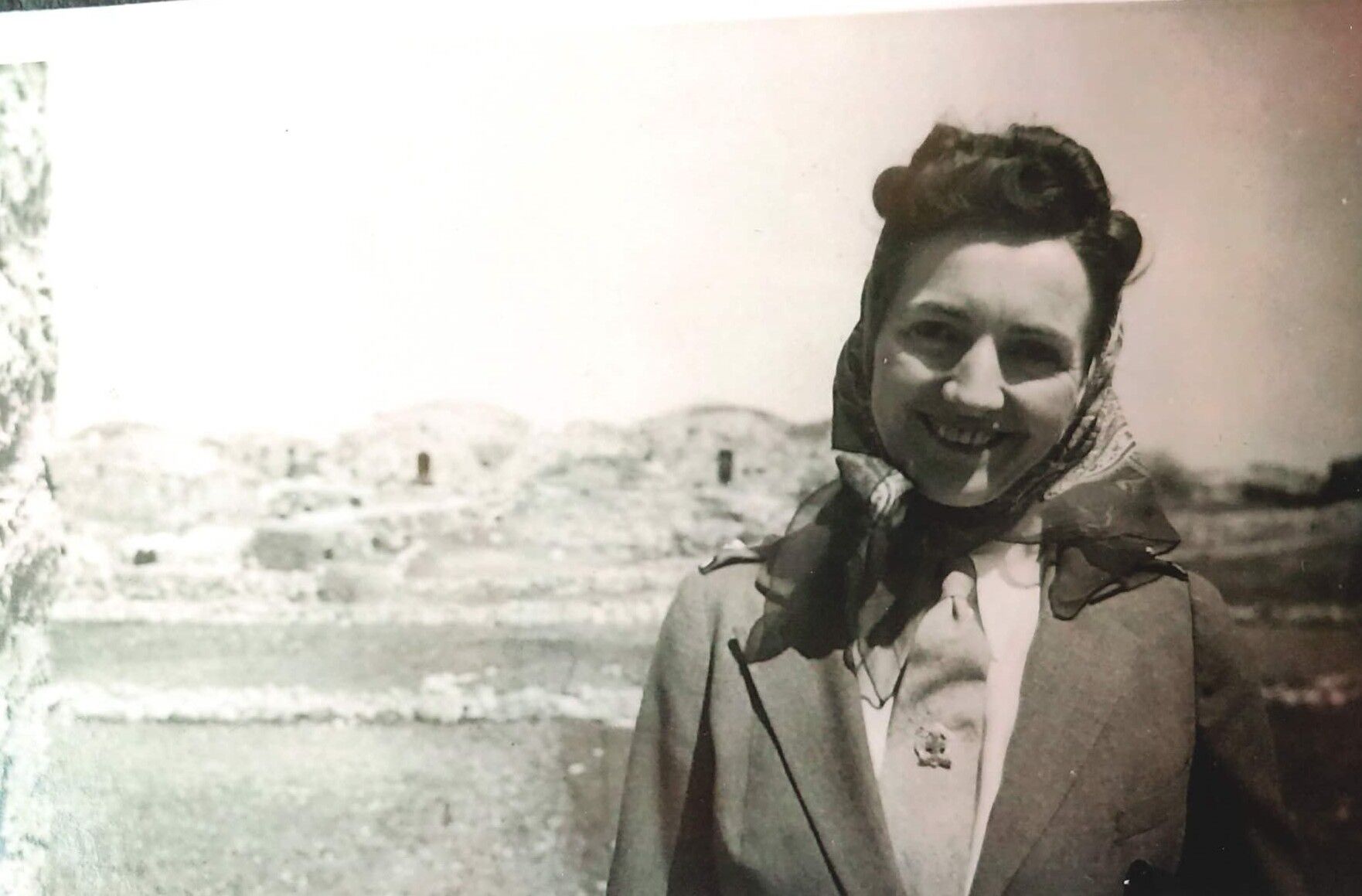
May Officer was a strong, singular woman who dedicated much of her life to the profession of nursing. For years, Pou Maumahara volunteer Judy Owen had known of an extensive family archive of letters penned by May, Judy’s great aunt. These letters, many of which were written during her service in World War II, convey her slightly eccentric personality and wide range of experiences during conflict.
In early 2026, copies of the letters came into Judy’s possession. Judy, herself a nurse who served with the New Zealand Red Cross for 40 years, was moved to see May’s life unfold before her in such frank and detailed correspondence.
With the assistance of the Online Cenotaph team, Judy has been able to share small pieces of this extensive family archive, allowing us insight into the life and service of her 'Aunt May' through her own words.
Early life and Enlistment
May was born in Mangaweka on 18 September 1902. She was one of five siblings born to parents Andrew and Lydia Officer (nee Mills), who had married in 1895.
On 6 July, 1937, May qualified as a nurse at Waipukurau Public Hospital, obtaining her Nursing Registration (No. 8943) after three years and three months of training.
While working in Christchurch at the Limes Private Hospital, May enlisted in the New Zealand Army Nursing Service (NZANS) on 4 October 1940. The beginning of May’s service was eventful, as her particularity and love of fashion had prompted her to reject the shape and colour of the NZANS. uniform hat. In protest, May had written to the manager of the hat factory requesting a change. This resulted in a somewhat severe reprimand from Matron- in- Chief Ida Willis on 14 November 1940.
"Dear Madam
The Manager of Treister Hat factory rang me today to say you had returned the grey and white hats ordered by you as you did not approve of the colour of the grey or the shape of the white hat.
It is not for you to approve or disapprove of the hats, but to accept what is sent you and if you were doubtful or not satisfied, you should have written to me first.
You are not the first nurse who has done this, and if you nurses are permitted to treat the Firms in this manner, I am afraid you may all have to go overseas hatless.
The grey hoods, chosen by me and made up and issued by Treister, are now a mottled gray, specially chosen for the New Zealand Army Nursing Service, and is the only one to be worn by the nurses when they leave this Dominion.
If you girls realized the difficulty of obtaining supplies needed to outfit you, you would be more than thankful that you have any uniforms at all.
I shall visit the factory and see the hats that have been returned.
Do not order any other hat in the meantime, as you must all be uniform in every detail and a plain grey will look very odd.
Yours faithfully
Matron in Chief."
Having acquiesced over the hat issue, May entered camp on 16 December 1940 and promptly embarked overseas, setting sail for Egypt on 19 December 1940 as part of the 4th Reinforcements. The convoy travelled from Sydney to Port Said, travelling via Fremantle, Trincomalee in Sri Lanka, Colombo, and the Suez Canal before reaching their destination. May eventually disembarked in Egypt on 28 January 1941 with the rank of Staff Nurse.
Letters from Egypt
Unfortunately, May had a difficult start to her time in Egypt, unsure whether she would be able to continue nursing while also struggling to adjust to life overseas.
“Well when I was discharged from hospital I was told by the Matron that if I had a return of eczema I would be sent home as the slightest thing makes it flare up in this country.
I was most nervous as I found everytime I put my hands in water back it would come. So, I wrote Miss Turner and I lost all fear of contact with water and have been alright ever since. I was so run down after having been seasick coming over and I loathed this place and was on the edge of a break down.”
May was passionate about both her vocation and her faith, leading her to become a Christian Scientist. The woman referenced as ‘Miss Turner’ in the above letter was a regular correspondent of May’s, and she often reached out to Miss Turner for support, guidance, and prayer.

During May’s time in Egypt, she worked primarily at No. 1 and No. 2 New Zealand General Hospitals (NZGH), although she also had a four-day stint at No. 3 NZGH. The New Zealand General Hospitals had to adapt to the changing demands of the war, relocating and reorganising as military operations shifted across the Middle East, North Africa and Italy.
Adaptability was also demanded of all the personnel serving in Egypt. Nurses like May were tasked to look after the wounded and ill servicemen from the Western Desert and Italian Campaigns, but they also found themselves dealing with the constant threats of ground attacks and air raids. The days were long and workloads were heavy. May and her fellow nurses frequently dealt with emotionally and physically challenging situations with a seemingly unending influx of the wounded.
“Did I tell you I am a reliever at present and work in a different ward each day relieving the one who has a day off – hence I walk into a ward where I know no body [sic] and find maybe 105 (sometimes more sometimes less) patients all strangers to me. I take up the thread of the work and get through despite my fears.
I find myself pulling back a sheet to find maybe two amputated legs, maybe one together with one arm and various other bodily wounds some of major and some of minor degree. One had not one square inch of his back which I could rub with methylated spirits as he had been blown up by a landmine and his whole back was covered with dressings. He was all smiles and had no complaints. I think he had a fractured leg also. We have the cream of the earth in hospital. Talk about brave uncomplaining and grateful men. They sacrifice their homes, wives and families, their jobs, their incomes and their lives for their country.”
May wrote of her work with passion but she did not hide the harsh and sometimes mundane realities of service.
“I am in night duty in the dysentery ward for one month which is situated in the hospital garden. Things are slack at present, so I am endeavouring to catch up with my letter writing (9.30pm – 7.30am). As I write giant ants run in every direction and mosquitoes boldly nip any part they can – legs, arms, and face. I usually wear long flannelette boots which protect my legs but being without any tonight I am a sight to behold. We are always equipped on night duty with helmet and respirator but have not had occasion to use it.”
Many of May’s letters also detail the chaotic and confusing aspects of life in conflict. Because much of her time was absorbed by regular, daily work, she was often unsure of the Army’s broader activities, and it seemed there was a lack of clear communication about her own position in the forces.
“I am unattached so may be moved on and become attached somewhere where needed. At present I am with 2nd General Hospital but do not belong to them. Things are quiet and up till recently we had mostly Australian patients. You realize I cannot tell you too much about the hospital so it will have to keep till I return. I think I told you it was once a grand hotel and that the ex-Kaiser spent his honeymoon in it.
I have not joined Freyberg’s circus (comprenez) [the 2nd NZ Division in the North African Campaign]. I am remaining put and I think I told you this hospital has changed its number and the No 2 girls who were here are now a mobile unit. They will be seeing and doing big things soon (I don’t know if I should be telling you all this).
If I move from here I’ll write ‘caravan’ at the top of my letter and you’ll know I’ve joined the circus as Lord Haw Haw calls it. The latest rumour I have heard is that I am now part of the 2nd General Hospital instead of an unattached of the 4th reinforcements. But no one knows anything in the army. We have almost an entirely new staff as this is now the No 1 General Hospital although we live still in the Grand Hotel. The No 2 GH are staying with us at present? Comprenez.”
This letter was not the first, nor the last, time that May had skirted the Army’s censorship policies to keep her family informed of her movements and daily activities. May made a habit of sharing confidential and potentially compromising information with her relatives back home in New Zealand with her quintessential quick wit and attitude.
“I have just given Mother an account of the last air raid which she will let you read. The moon is on the wane - consequently Gerry has not turned up the last two nights. I fire my bombs back at him believe you me as Dad would say. By the way – the last air raid lasted two hours (if the censors see this I’ll get my ears tweeked).”
May spent just over three years in Cairo and, amongst the mundanity and work, her letters also detailed time spent at dinners, dancing, and sightseeing.
“I was on duty the day Lady Lampson opened the NZ Club. Otherwise, I would have been there. We are about 50 miles from there. It is an excellent club, but it is at times very crowded and not half big enough…
Girls in NZ wouldn’t dream of going into hotels and drinking but over here everybody does. Many go to the bars but most sit in the open-air lounges or the inside lounges. Whiskey is a favourite drink and it is nothing to see the girls take three whiskies. I usually take lemonade but occasionally I take Gin, lime and water to be sociable. However I don’t like it a bit as it makes my head wiz too. So, I now stick to lime and lemonade.”
The nurses busy social calendars offered some respite the long working hours, with May and her fellow sisters attending several weddings.
“We had a wedding the other night. One of our sisters Sister Barker who was tutor sister at the NP Public Hospital before the war was married to Sergeant Walter Brown from NP also. They met over here.
We were all amazed when we heard a wedding was to take place as we were under the impression that no sister could marry over here. This is the first in the NZANS and not likely to be the last in fact another one is to take place next month. Unfortunately, the brides must return to NZ on the first boat to go after the wedding takes place. It so happens that Sister Barker was returning to NZ in any case as the climate had been too much for her.”
Sister Eileen Barker and Sergeant Walter Brown, both from New Plymouth, were married at St Paul’s Church, Helwan, Egypt. Their wedding was reported as the first between a New Zealand nurse and soldier serving overseas during World War II. At the time, nurses serving with the NZANS were required to be unmarried, and Barker was subsequently required to return to New Zealand.
Family reunion
As was the case with many New Zealanders, May was not the only person in her family to serve in World War II. May’s nephew Ashley John Picard (John) joined the Army on 25 July 1940 at the age of 18, and May made sure to give out stern advice on his upcoming training.
“It is hard to realize that John is in camp. Make him sit for a commission otherwise he’ll be out of everything and will have to rough it everywhere. He has the brain, so you make him do it. Tell him I strongly advise it and it is much better to obtain it before leaving NZ than to go into training school here.”
While he did not heed May’s advice, John did train in New Zealand as part of the Queen Alexandra’s Mounted Rifles. This training continued until July 1943 when he was posted overseas as part of the 10th Reinforcements.
By the time John arrived in Egypt on 18 August1943, May had already been serving there for over two years. Though May would have undoubtedly been happy to see a familiar face, her earlier letters home suggest that the violence she had witnessed during her own service made her fearful of John’s enlistment.
“I hope John doesn’t come over here and yet if he does well I expect we should not complain seeing it is the lot of so many Mother’s sons.”
Perhaps in an effort to quell her concerns, John organised a meeting with May, which he described in detail in his 29 August 1943 letter to family.
“I wrote to Aunty May the day before yesterday and made arrangements to meet her on the Monday and I had just posted the letter when one arrived from her saying that she was leaving on the train for a week’s holiday in Alexandria and a week at Port Said so I asked the troop officer for leave and Sandy and I went into town and met her at the station.
It was rather funny. I told Sandy to watch for her in one place and I would watch the other. I told him what she was like and we started watching. I couldn’t see her around my way, so I went back to Sandy and 2 nurses were getting out of a car and Sandy asked if she was one of them. And I said No but when they got level with us one of them had a smile on her face and I saw then it was Aunty. I am sure I wouldn’t have known her if she hadn’t smiled and when I spoke to her, she started to walk on and then recognized me. Believe me we were pleased to see each other, and we only had about ¼ of an hour before the train went so as you can guess there was a lot of chin wagging. Aunty has lost a lot of weight and is looking marvellously fit and well, we didn’t have much time to talk so I am going out to Helwan on my first leave after she returns.”
That same letter also details John’s meeting with another family member, this time his cousin Eric Lagerstedt.
“I ran into Eric Lagerstedt last night. I had just been to the RAP [Regimental Aid Post] and called into the canteen for a library book and there is a chap there Bullick from Dannevirke that I know here with us and he was talking to Eric. At least I thought it was Eric but I wasn’t sure, so I asked him and it was OK. He has been over here about 2 years and is a real wreck he isn’t much over 10 stone. So now I have seen all my relatives over here.”
In late October 1943 the New Zealand Division was sent to take part in the Italian Campaign. John remained with the 32 NZ Field Regiment until April 1944 when he joined the 7th Anti-Tank Regiment, who he was stationed with until the end of the war. The 7th Anti-Tank Regiment, with which he served, was a frontline unit and was involved in several significant actions in the Italian Campaign including Cassino, Florence, and Faenza before finishing in Trieste.
John left Italy to begin his journey home on 16 April 1946, eventually arriving back in New Zealand on 28 May 1946. He then married Nyla Riley, had five children and worked as a dairy inspector for many years. John died in 1985 in Whakatane and is buried in the Whakatane Cemetery.
Life after service
While John served until the end of the war, the regulations for nurses were different to other personnel. In 1941, the New Zealand Nursing Council and the war cabinet had decided that sisters aged 35 or over, particularly sisters over 40 years old, were not allowed to re-employ for additional overseas service upon returning to New Zealand. Many nurses were unaware of the rule when they first embarked, resulting in them attempting to delay their return to New Zealand by any means possible so they could continue to serve. In total, May was allowed to serve for 3 years and 54 days before being struck off strength at the rank of Sister on 9 May 1944.
When May arrived back in New Zealand after her discharge, she wrote to a Miss Lambie to request that she be allowed to continue to serve, expressing a strong desire to support the ongoing needs of the war effort.
“Dear Miss Lambie
Since returning from the M.E. after three years’ service with the N.Z.A.N.S. I have been discharged on account of the age limit imposed on sisters for overseas service and I have been placed on the reserve of the N.Z.A.N.S.
My health record was good, and I was always given to understand from all concerned that my work was appreciated at the No 1 G.H. in the ME.
As I am very desirous of carrying on with Army Nursing overseas, I respectfully request permission to apply to the Q.A.I.M.N.S (Queen Alexandra’s Imperial Military Nursing Service) to join them for this purpose.
I understand from Miss Willis that there is an urgent need of sisters in the QAIMNS and this makes me all the more anxious to continue army nursing.
I shall be most grateful if you will consider this application and for your good offices in forwarding it to the appropriate authorities for final determination.
Yours faithfully
May Officer (Sister)”
Unfortunately for May, the response from Matron in Chief Ida Willis, dated 27 March 1944, confirmed that her wishes would not come to fruition.
“Dear Miss Officer
Your letter of 17 March 1944 has been referred to me. In the matter of your age our records have your date of birth as 18 September 1902, so the Posting Committee form is a clerical error and will be rectified.
Being placed on the N.Z.A.N. S. Reserve means that, if necessary, you will be called on at some future date. In the meantime, you will go back to civilian life where your services are urgently needed. There is no army post open for you in NZ. All the camp hospitals are staffed with sisters preparing for overseas service. The only posts are W.A.A.C Camps where you would not find very much scope.
Actually, all the nursing of returned servicemen is done in Public Hospitals or in the Health Dept Institutions such as the all services Hospital at Rotorua/ if you applied to Miss Lambie she would advise you where your service is most needed.
Yours faithfully
I Willis
Matron in Chief”
Instead of returning overseas, May continued to work in civilian nursing and, in 1946, she married Alfred Norman Walpole Francis. Norman was born 30 October 1911 in Feilding and had also served as a Lance Corporal in the NZ Armoured Corps Infantry Brigade. May and Norman lived their lives at Pakihikura, Hunterville. They had no children.
May remained a keen correspondent throughout her life. The determination and forthrightness evident in her wartime letters remained with her into later life, and she continued to write on matters that concerned her with characteristic wit.
Norman died on 19 September 1979 and May died 17 August 1986. Both are buried in the RSA plot of the Ashhurst Cemetery.
Although it has been decades since her death, May’s letters allow her memory to live on, painting a vivid picture of a woman whose endurance and humour were never quelled by the hardships of conflict.
In February 2025, Judy Owen also shared with us the story of her father, Malcolm Dick Cunningham Owen, and his service in the Arctic Convoys. You can read the Cenotaph Story about his experiences here.
Tohutorohia tēnei tuhinga
Elborough, Sophie. Great Aunty May: Letters from Egypt. Auckland Museum - Tāmaki Paenga Hira. First published: 3 Mah 2026. Updated: 25 Mah 2026.
URL: https://www.aucklandmuseum.com/mi/war-memorial/online-cenotaph/features/great-aunty-may