
Serving in Somalia: The New Zealand Supply Detachment, 1993
In late 1992, New Zealand joined the United Nations Operation in Somalia (UNOSOMI), an international mission responding to famine, civil conflict, and the collapse of infrastructure across Somalia. Images of starvation and violence had shocked international audiences, and countries including New Zealand contributed personnel to support humanitarian and peacekeeping efforts.1
New Zealand’s involvement included the deployment of the New Zealand Supply Detachment (NZSUPDET), a logistics unit responsible for supporting operations in Mogadishu through the supply of fuel, rations, equipment, and transport support.
Among those who served was Michael 'Mike' Mendonça MBE, who deployed to Mogadishu in January 1993 as part of the New Zealand Defence Force logistics contingent. His reflections provide insight into the realities of peacekeeping service and the emotional complexity of operating in a war zone. Mendonça later observed that military service in Somalia could be “the saddest, happiest, most frustrating, most rewarding, depressing, incompetent yet hilarious experience, sometimes all on the same day.”2
More than thirty years later, Somalia remains one of the defining experiences of Mendonça’s military service. His reflections move between the operational realities of the deployment and the enduring emotional impact it had on those who served there.
Arrival in Mogadishu
After delays in both New Zealand and Kenya, the main body of the New Zealand Supply Detachment arrived in Mogadishu on 8 January 1993, joining a small advance party already in theatre.
Operations were established at the airport and seaport, with additional support links running through Nairobi in Kenya. The detachment’s role focused on logistics and sustainment, including transporting supplies, maintaining vehicles and generators, establishing camp infrastructure, and helping provide fuel, food, and equipment to United Nations personnel operating across Somalia.
The city they entered had been heavily damaged by years of civil conflict. Infrastructure had collapsed and many buildings stood in ruins.
For many New Zealand personnel, Somalia represented their first experience operating in an active humanitarian crisis zone. Mendonça observed that political discussions about the conflict often failed to capture the realities visible on the ground.
“It’s one thing for diplomats to speak of how the end of the cold war left a power vacuum on the horn of Africa, and how this led to a breakdown in civic administration and infrastructure. It’s quite another thing to see what that actually looks like.”
Across Mogadishu, the effects of famine, conflict, and the collapse of civic infrastructure were immediate and confronting. Ruined buildings, armed violence, widespread hunger, and displaced civilians formed part of everyday life in the city.
One of the strongest memories Mendonça retained from the deployment was the human impact of conflict and displacement. “[T]here are photographs and documents, useful factual reminders for sure of what happened, but it’s the feelings that have endured.”
One encounter remained particularly vivid. At a checkpoint, he gave water to a young boy who had lost both hands during the conflict. As the convoy drove away, he saw other children move towards the boy to take the bottle from him.
“I often wonder what ever became of that kid. Sometimes when things are tough at work I think about that kid and things don’t seem so tough any more.”
For many New Zealand personnel, the scale of human suffering they encountered in Somalia remained difficult to forget.3
Reflecting on the deployment, Mendonça identified three emotions that remained with him long after returning home: anger, whanaungatanga, and pride.
Anger
The first of these emotions was anger.
For Mendonça, this anger was directed not only at the suffering caused by the conflict itself, but also at the failures and frustrations that surrounded the humanitarian response.
New Zealand had joined the United Nations mission to help stabilise conditions and support the distribution of aid. However, Mendonça later reflected that the mission gradually shifted from humanitarian support towards attempts to capture or confront Somali military leaders, an example of what he described as “mission creep”.
There were also frustrations closer to home. Members of the advance party arrived without adequate protective equipment. “The advance party had no weapons, no body armour and no helmets.” Administrative and logistical problems remained unresolved, while pay and leave arrangements caused ongoing frustration amongst deployed personnel.
Despite these challenges, the New Zealand contingent quickly adapted to conditions on the ground. Mendonça recalled that once personnel arrived in Mogadishu, “it was as though an invisible energy had arrived”, as the contingent established camp operations and got to work.
Taniwha Hill
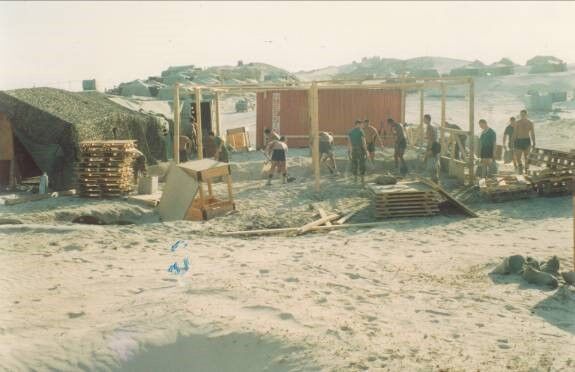
The New Zealand contingent quickly established its own camp at the airport, later known informally as “Taniwha Hill”.
Personnel constructed accommodation, ablutions, cooking areas, workspaces, and recreation facilities while simultaneously supporting operational logistics tasks. Conditions were difficult and often improvised. United Nations equipment was frequently ageing or unreliable, and many systems normally supporting military operations were absent.
Adaptability quickly became essential to daily life.
Vehicles and generators required constant maintenance, camp facilities had to be constructed from limited resources, and practical solutions were often developed on the spot. Despite these challenges, humour and camaraderie remained important parts of the deployment.

Fresh food and water supplies were sourced locally where possible, and New Zealand personnel established cooking areas and shared meal routines that helped maintain morale. Makeshift hāngi and barbecue areas became gathering places for the contingent during periods away from operational duties, helping maintain morale and a sense of connection to home.
The arrival of Royal New Zealand Air Force (RNZAF) Andover aircraft in early 1993 also became an important morale boost. The aircraft and crews supported transport and logistics operations while reinforcing the sense of connection with New Zealand.
Although the work was demanding, New Zealand personnel approached the deployment with humour, practicality, and a willingness to “drive anything, fire anything, fix anything, talk to anyone”.
Whanaungatanga
Whanaungatanga, the sense of kinship, shared connection, and collective responsibility formed through relationships and shared experience, became one of the strongest enduring aspects of the deployment. Shared hardship, uncertainty, humour, and reliance on one another created close bonds amongst those serving in Somalia.
Three rotations of New Zealand Army logisticians deployed to Mogadishu between November 1992 and September 1993, with later rotations joined by infantry personnel to strengthen security arrangements. Each rotation developed its own whanaungatanga, culture, humour, and shared experiences under difficult operational conditions.
The security environment in Mogadishu could change rapidly. Periods of relative routine were interrupted by mortar fire, sniper attacks, and escalating violence involving militia groups and United Nations forces. In June 1993, New Zealand personnel were temporarily confined to secure operational areas as violence intensified across the city.
The ongoing pressures and unpredictability of deployment helped forge strong bonds between servicemen and women from different backgrounds and units. Mendonça reflected that many of these connections remained significant long after they returned to New Zealand. Humour and camaraderie became important ways of coping with difficult circumstances.
New Zealand service personnel often approached challenges with “a black sense of humour and a certain irreverence and disregard for the rules.” Shared meals, practical jokes, and collective problem-solving all contributed to the sense of kinship that developed amongst the contingent.
Mendonça also believed tikanga and Te Ao Māori played an important role in shaping the identity of the New Zealand contingent within the multinational peacekeeping force. New Zealand personnel regularly interacted with troops from many different nations and cultural backgrounds. Waiata, humour, shared meals, and haka helped establish connections with other contingents and contributed to a distinct New Zealand identity within UNOSOM.
This became particularly important within such a diverse multinational force. On one occasion, an Islamic contingent presented the New Zealanders with live goats as a gesture of thanks and hospitality. Unable to bring themselves to slaughter the animals, New Zealand personnel quietly returned the goats overnight to the herd belonging to the contingent who had gifted them.
In Mogadishu, Anzac Day 1993 became one of the most memorable moments of deployment. Mendonça recalled RNZAF Andovers flying low overhead at dawn, the singing of Whakaaria Mai filmed by CNN, haka performances, donkey races with Australian personnel, and a hāngi shared with troops from multiple nations, including Turkish soldiers serving alongside the United Nations force.
In an environment marked by instability and tension, these moments of connection and shared identity became some of the most enduring memories of the deployment.
Pride
The final enduring emotion was pride. For Mendonça this pride existed on several levels: pride in New Zealand and its people, pride in the conduct of the contingent in Somalia, and pride in the lessons learned through leadership and service under pressure.
Although the Somalia mission became associated with significant political and operational challenges, Mendonça believed the service of New Zealand personnel deserved greater recognition within New Zealand’s military history.
New Zealand troops developed a reputation for resilience, adaptability, humour, and a willingness to engage positively with people from different backgrounds and cultures.
“We are lucky to call Aotearoa New Zealand home. Generally, no-one naturally hates us, and we tend to take everyone and everything at face value.”
Mendonça believed these qualities shaped the way New Zealand personnel operated in Somalia, often forming strong working relationships with other contingents despite difficult circumstances.
As the security situation deteriorated throughout 1993, New Zealand personnel continued carrying out logistical and support responsibilities under increasingly dangerous conditions. Mortar attacks, sniper fire, and escalating violence remained ongoing risks across Mogadishu, and periods of heightened tension confined some personnel to secure compounds and operational locations. Mendonça later described Mogadishu as “a tinder box, ready to light up at any time.”
Despite the difficult operating conditions and numerous close calls experienced during the deployment, all New Zealand personnel returned home safely. The Somalia operation nevertheless claimed the lives of more than 160 peacekeepers from multiple nations. United Nations operations in Somalia formally concluded in 1995, although instability and conflict continued in the region for many years afterwards.
The experience also shaped Mendonça’s understanding of leadership, responsibility, and service under pressure. He reflected on the importance of trust, judgement, and values when operating in environments where clear answers were often absent.
He later wrote that he was fortunate to serve alongside leaders such as Lieutenant Colonel David Haynes and Warrant Officer Tony Harding, whom he described as “tough family men with unwavering loyalty, integrity, values and humility”. He reflected that “you couldn’t ask for better leaders to keep you honest when you might be uncertain or wavering.”
For Mike, the strongest enduring memories of Somalia are not solely the dangers or frustrations of the deployment, but the sense of whanaungatanga and pride that developed amongst those who served together.
“Sometimes I still feel a bit angry about that, but mostly from my time in Somalia I feel a powerful sense of whanaungatanga and pride.”
The service of New Zealand personnel in Somalia remains an important chapter in the history of New Zealand peacekeeping and operational deployments overseas, reflecting both the challenges of humanitarian operations and the enduring bonds formed through service.
Ngā mihi
Online Cenotaph thanks Mike Mendonça MBE for sharing his reflections and experiences of service in Somalia. Contributions such as this help preserve the lived experiences of New Zealand personnel who served on peacekeeping and humanitarian operations overseas. Mendonça was appointed a Member of the Order of the British Empire (MBE) in 1994 for his services and leadership in support of United Nations operations in Somalia.
This article is adapted from Anger, Whanaungatanga and Pride: The New Zealand Supply Detachment, Mogadishu, Somalia 1993. Reflection of a New Zealand soldier thirty years on by Mike Mendonça, first published in The Volunteers (March 2023), Volume 49, No. 3.
References
1 United Nations. (n.d.). United Nations Operation in Somalia II (UNOSOM II). United Nations Peacekeeping; Wikipedia contributors. (n.d.). United Nations Operation in Somalia I.Wikipedia. Retrieved July 7, 2026, from ; Crawford, J., & New Zealand Defence Force. (1996). In the field for peace : New Zealand’s contribution to international peace-support operations, 1950-1995. [Wellington, N.Z.] : New Zealand Defence Force.
2 This article is adapted from Anger, Whanaungatanga and Pride: The New Zealand Supply Detachment, Mogadishu, Somalia 1993. Reflection of a New Zealand soldier thirty years on by Mike Mendonça, first published in The Volunteers (March 2023), Volume 49, No. 3.
3MacDonald, C., New Zealand War Pensions Medical Research Trust Board, & Massey University Department of Psychology. (1996). Psychological effects of peacekeeping deployments on military personnel : a report. Dept. of Psychology, Massey University.
Further Reading
Wikipedia contributors. (2026, March 19). New Zealand Supply Contingent Somalia. In Wikipedia. Wikimedia Foundation.
McGibbon, I. (Ed.). (2000). The Oxford companion to New Zealand military history. Auckland, N.Z.: Oxford University
Tohutorohia tēnei tuhinga
Mike Mendonça and Victoria Passau. Serving in Somalia: The New Zealand Supply Detachment, 1993. Auckland Museum - Tāmaki Paenga Hira. First published: 7 Hōn 2026. Updated: 25 Mah 2026.
URL: https://www.aucklandmuseum.com/mi/war-memorial/online-cenotaph/features/somalia