
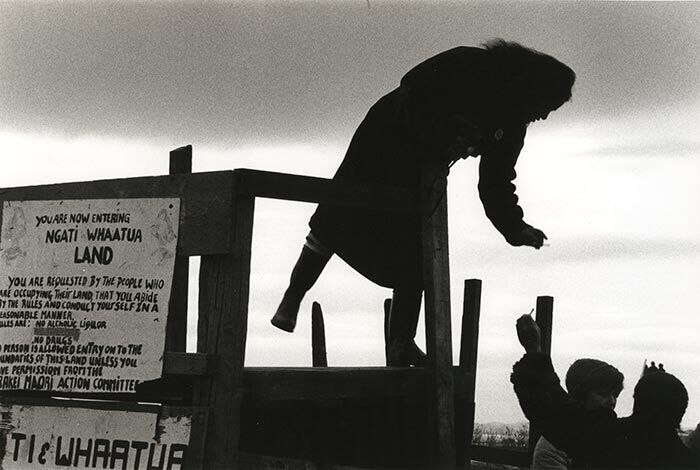
On 25 May 1978, a convoy of military vehicles carrying 800 police and soldiers left Hobsonville air base on its way to end the Māori occupation of Bastion Point/Takaparawhau. Ngāti Whātua protestors and supporters had been peacefully occupying the point for the past 507 days, following the government’s announcement to subdivide and sell the land (which it wrongly claimed was its own).

The police arrived and encircled the occupation. The protestors started singing hymns and waiata. Some of the kaumatua/elders left or were led away and then the police moved in, targeting the men first. Two hundred and twenty two people were arrested.
Robin Morrison was deeply moved: “I certainly got the feeling of the horror really, that’s the only way I can really put it of seeing those hundreds and hundreds of police descending on that small community. And whatever the rights and wrongs of that protest movement it certainly made me feel very—almost desolate—about New Zealand’s future if a government could send in the paramilitary really, that’s what it was, into that Māori marae.”
The use of such overwhelming force to end the peaceful occupation highlighted the legacy of discrimination against Māori and the state’s ongoing appropriation of Māori land. The occupation became a major landmark in the history of Māori protest and helped to open Pākehā eyes to the country’s history of injustice.
Learn more about the occupation of Bastion Point / Takaparawhau
1999 TV documentary: Bastion-Point – The Untold Story
Bastion-Point – The Untold Story features extensive interviews with protest leader Joe Hawke, and footage from seminal documentary Bastion Point Day 507. Watch it on NZ On Screen.
Bastion Point
Read the Wikipedia summary of the history and occupation of Bastion Point.
Ngāti Whātua Ōrākei
The people of Ngāti Whātua Ōrākei are a hapu (sub-tribe), of the Ngāti Whātua iwi (tribe) based in Tamaki Makaurau (Auckland).