
For Easter, we visited our Applied Art and Design galleries to photograph this beautiful enamel missal cover. Curator Damian Skinner provides a short history of how the French city Limoges, where the cover was made, became famous in the Middle Ages for this style of champlevé enamel.
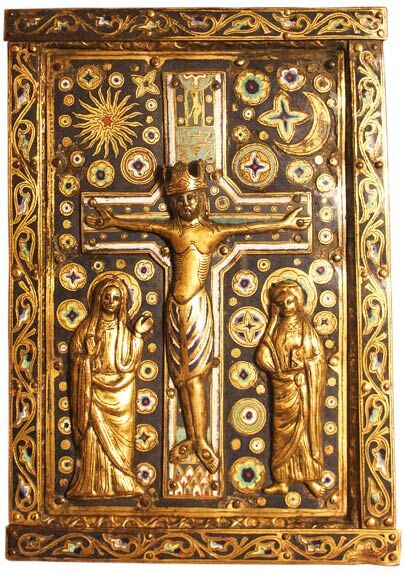
A missal is a book that contains prayers, readings and instructions from which a priest celebrates mass through the course of the year. This missal cover is made of champlevé enamel and was produced in the French city of Limoges in the 13th Century.
Limoges enamels became famous after the first workshops were established in local monasteries in the 1200s, and a huge export trade sent religious or ecclesiastical objects into church treasuries around Europe.
Located on many trade and pilgrimage routes, Limoges had a thriving economy and wealthy monasteries that created the perfect conditions for its enamels to become the primary industry of the city. It was thus the premier European source of enamel objects until 1371, when Limoges was invaded by Edward the Black Prince from England.
There is a strong connection between Limoges enamels and those of the Mosan School from the Meuse valley in what is now Belgium. Both traditions favoured the champlevé technique, and had similar colour schemes (blue, yellowish green, white and red), although Limoges enamels are quieter and less expressive than those from Mosan.
Champlevé enamel is created by placing enamel into cast or worked recesses in a metal surface, which is then baked at low temperature. Enamel is a mixture of silica (the same substance as glass), pigment to create colour, and a fluxing agent like soda, lime or borax, which fuses the ingredients during baking.
The use of such a beautiful hand crafted technique demonstrates the great importance of these liturgical books for the church. Missal translator and editor Abbot Dom Gaspar Lefebvre wrote in 1951: ‘In the light of the sacred text contained in the Missal, the altar becomes each day before our eyes a corner of Palestine, where we celebrate with Jesus the events of His life; His coming (Advent), His birth (Christmas), His preaching (Lent), His suffering and death (Passion), His resurrection (Easter), His ascension and the coming of the Holy Spirit (Pentecost) whereby we receive those special graces which Holy Communion infuses into our souls.’
Visit Auckland Museum
You can see the missal cover on display in the Landmarks gallery.
Discuss this article
Join the discussion about this article by posting your reponse on Twitter, Facebook, or Instagram using the hashtag #amdiscuss.