
Many of the beautiful cities of the world began on the edge of a protected harbour. Auckland is no exception. In 1840, the local chiefs of Ngāti Whātua invited colonial governor William Hobson to establish a capital on the banks of their land in Waitemātā. Changes in politics and power led to the capital being moved to Wellington in 1865, but not before Auckland was well-established as a trading, land speculation and mission town.
Among the oral and written histories that record Auckland’s beginnings, are the visual histories: paintings and drawings by professional artists and talented amateurs. We have selected three depictions of the early city and harbour held in our Pictorial Collections to celebrate the city's 175th anniversary.
Amateur artist John Johnson
The creator of these two impressions of early Auckland, John Johnson (1794-1848), was one of the colonial officials, a doctor and amateur artist. In his book Painting the Frontier: The Art of New Zealand's Pioneers, author David Filer explains how Johnson "had been appointed Colonial Surgeon in Sydney and soon after arriving in New Zealand had treated Hobson, who suffered a stroke in March 1840."
Filer notes how the work of the amateur artists showed their fascination with the dramatic landscape, and how they contributed to a body of work that showed "life on the edge of the New Zealand frontier".
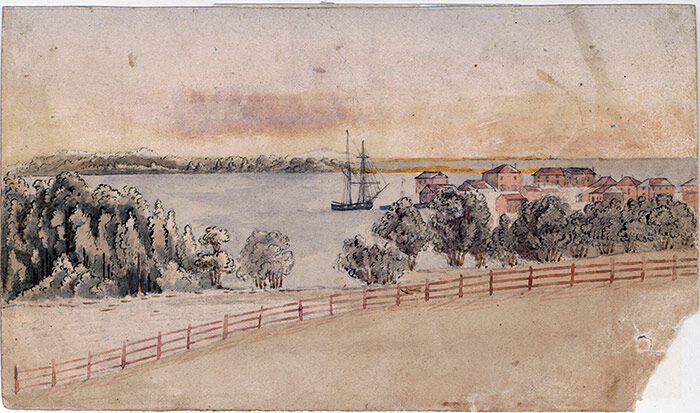

View this photo on our library catalogue
Artist and architect Edward Ashworth
Wikipedia records Edward Ashworth (1814-1896) as "an artist and architect from Devon, England, considered to be the West Country's leading ecclesiastical architect". During 1842-46 he travelled to New Zealand and Hong Kong, and drew places and buildings around colonial Auckland. Auckland Art Gallery hold several from this period and even one of a modest house he designed for himself.
This 1843 painting, held in the Museum's collection, shows early Queen Street with its colonial government and private buildings: the Court House, the Stocks, Blue Bell Inn, the Post Office and probably the Wheat Sheaf Inn and Custom House. His building renders are fairly technical, but he shows a softness and sensitivity for the colour and spatial aspects of the landscape.
View this photo on our library catalogue
Further reading
The founding of Auckland: 1840–1869, Te Ara – The Encyclopedia of New Zealand
Painting the Frontier, The art of New Zealand's pioneers by David Filer
Find out more about our Pictorial Collections. We hold one of the nation's most important collections – a wealth of historic paintings, rare watercolours, photographs and other artworks.
Discuss this article
Join the discussion about this article by posting your response on Twitter, Facebook or Instagram using the hashtag #amdiscuss.